Visions of Chicano Park (Barrio Logan, San Diego)
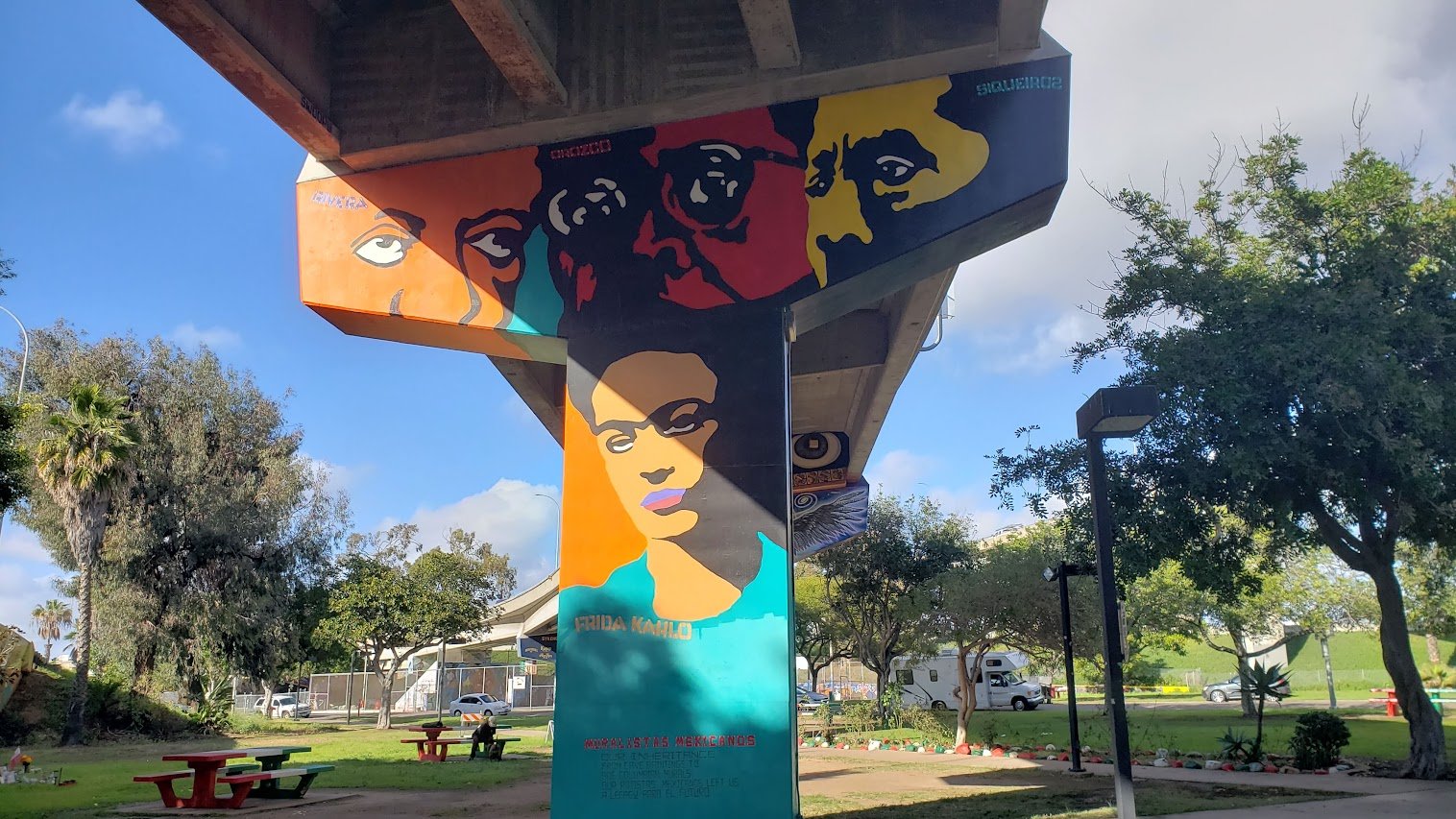
Mural of painter Frida Kahlo, and muralists Diego Rivera, José Clemente Orozco, and David Alfaro Siqueiros photo by Dan Grossman
I frequently visit Chicano Park in Barrio Logan, San Diego. Lately I’ve been trying to capture the passage of time there with my panoramic photography.
The park, located under the San Diego-Coronado Bridge, is known for the murals that populate the bridge abutments, columns, and walls of surrounding city structures.
Some of the murals speak to the history of largely Mexican-American Logan Heights, a community which lost thousands of homes to make way for the highways that split it in two. But the murals reach back deeper in time than the concrete and rebar planted in the bedrock. They reach all the way back to the Americas before the Treaty of Guadalupe Hidalgo, before colonization, all the way back to the Aztec gods. Some of the murals speak to gentrification, which has caused more displacement of long-term residents as businesses and apartment blocks go up catering to wealth in one of America’s most expensive cities. But this is nothing new: Chicano Park was born in a fight pitting residents against political and economic power.
In 1969, activists won approval of the park site in its current location by the San Diego City Council. However, no action towards park development was taken. Instead, bulldozers were moved in to begin construction under the bridge on a California Highway Patrol Station and a parking lot. The community rebelled. Local high school students joined the protests. Activists formed human chains around the bulldozers, and planted trees, flowers, and cactus. The occupation of the park lasted 12 days, and the city was forced to negotiate with the community.
And Chicano Park was born.
Something’s always going on in the park. Lowriders regularly line up in the middle of Logan Avenue and their owners talk shop about hydraulics and suspension as their vehicles pop up and down like horny teenagers under bedsheets. I’ve talked to artists at their easels, as attracted to the dizzying urban geography of the park as I was. I’ve seen exhibitions of Aztec dancing, talked to family members honoring their relatives with altars made from memorabilia, and purchased $1 chicken tacos at La Central Market—which sells much more alcohol than tacos. Sometimes I catch a glimpse of the monthly steering committee meeting taking place on the kiosko, an open-air patio that resembles its Aztec and Mayan antecedents. Judging from these packed meetings, it doesn’t seem like they have a problem attracting volunteers to help maintain the park.
In April, 2025 I visited the Chicano Park Museum and Cultural Center, within sight of the kiosco. On display were colorful silkscreen posters by Sacramento-ibased Ricardo Favela and the artists of the RCAF (the Royal Chicano Air Force) as part of the museum’s two-year anniversary celebration. The work, much of it reminiscent of the psychedelia popular in the 1960s and 1970s, promoted political talks, art shows, and performances.
Favela and his group aimed to make “cultural arts accessible to the working class” per the wall text. There was something nostalgic about his work and a little sad, making me wonder if activism on a monumental scale—to effect monumental change—was either a thing of the past or something that could easily be snuffed out in the age of AI-assisted surveillance. Or both.
I visited the gift shop afterwards. On the wall beside the door, in English and in Spanish, I noticed a poster outlining what to do “IF YOU SEE ICE.” The posters reminded residents to react appropriately when they see Immigration and Customs Enforcement agents—reminding them to verify the identity and purpose of the agents, to document their activity, and to spread awareness rather than fear.
I asked the woman behind the museum desk if any ICE agents had made their presence known in Chicano Park and Barrio Logan. She said there hadn’t been any sightings in the park but during the previous night there had been sightings of ICE agents “hiding in alleys” conducting operations along Logan Avenue.
Struggles with law enforcement are also nothing new to Chicano Park.
In September 2024, I watched with a resident named Gabriella and her 10-year-old daughter as dozens of San Diego police entered the park, after blocking off northwestbound National Avenue with their vehicles. She identified a bearded man, dressed like he was homeless, as undercover law enforcement. A few minutes later, as if right on cue, he went over to talk with the cops. Later, when I asked one of the officers why they were there, he told me they were removing gang graffiti from the bathroom. But their presence seemed less like a beautification campaign and more like a show of force.
As Trump 2.0 began, I kept wondering when I would see ICE in action around Chicano Park and in the surrounding neighborhoods of Logan Heights and Barrio Logan. I haven’t yet seen ICE agents arriving, say, to whitewash the murals and arrest protesters. But they’ve been active: ICE’s deportation tracker shows that, for San Diego as a whole, there have been a total of 3,701 arrests in 2025.
Maybe it’s a conscious decision on their part, for now at least, to operate largely in the shadows.
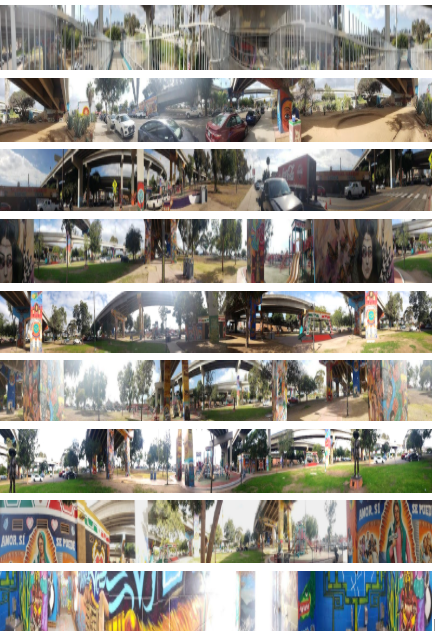
Chicano Park Panoramas