The Traveling Tables of Amistad: Making Friends across the Border in Mexico
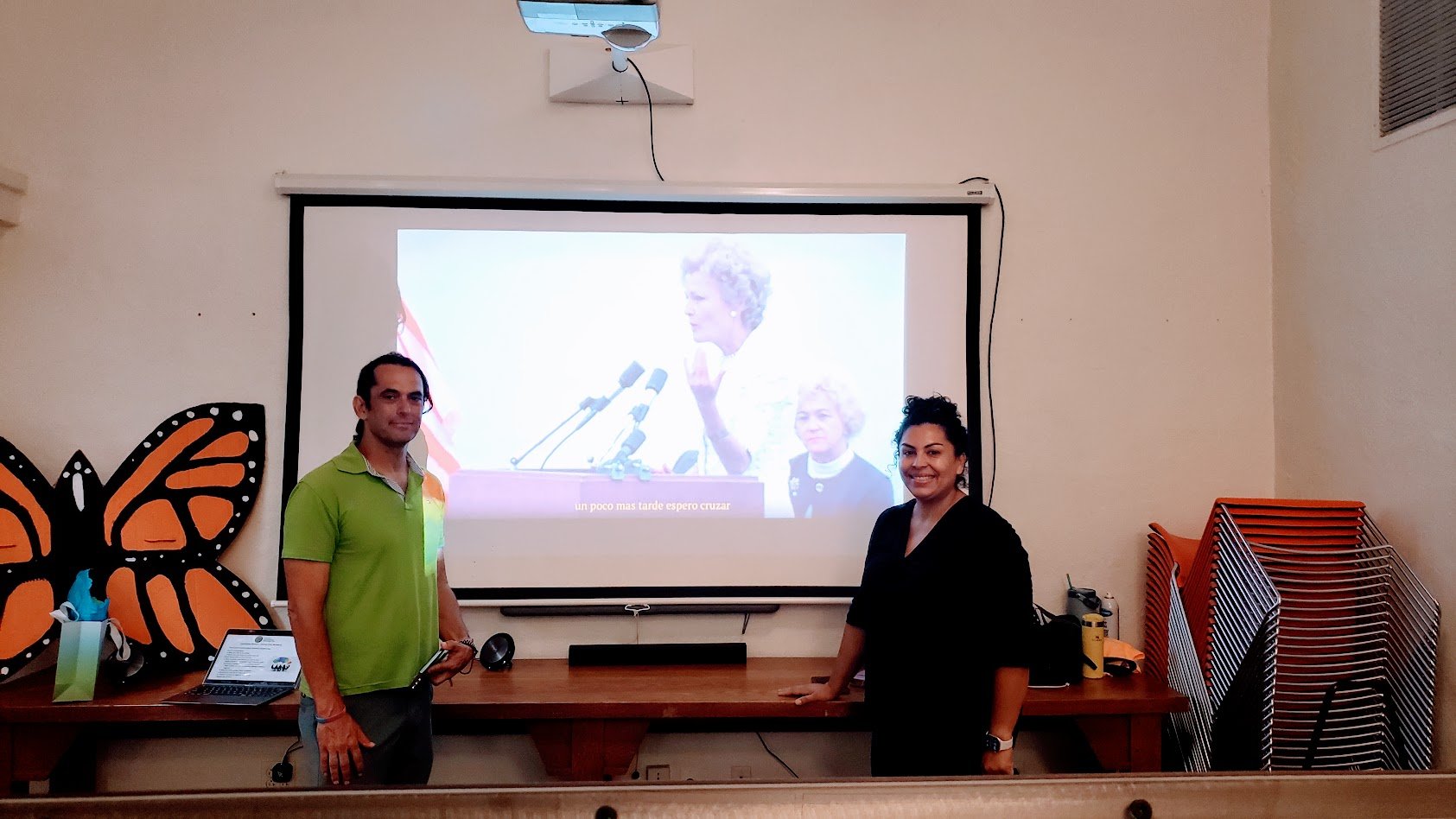
Dan Watman, Program Director of Friends of International Friendship Park and Executive Director Rosa María Hernández
On September 6, I stopped by the Museum of Us in Balboa Park to check out an exhibit titled The Traveling Tables of Amistad—three tables made from sections of the former border wall that had once stood at Friendship Park. The park is situated at the southwesternmost corner of the US, where San Diego and Tijuana meet at the Pacific Ocean.
The sections had been removed when a new fence was installed.
It was the first day of the exhibit, on view through September 19 and organized by the Friends of International Friendship Park. Along with the tables, the exhibition includes a short film on the history of the park.
For decades, the posts from the border wall served as canvases for hundreds of artists who painted colorful designs on the rusting metal along the Mexican side of the border. After the sections of wall were taken down, the Museum of Us helped store them. Each section—21 in all—is 18 feet high, eight feet wide, and weighs more than 4,000 pounds.
What is on view at the Museum represents only a small part of this stored material. Rusted, covered by many layers of paint, these sections of fence served as silent witnesses to decades of change on the US-Mexico border.
In their original form, however, these sections had been too heavy to fashion into tables or indoor displays of any kind.
Enter Michael Leaf.
The San Diego area sculptor and designer first removed the cement and rebar from the interiors of a section of fence posts, chopped them in half, and laid them side by side, closing the gaps between them and enclosing them in glass.
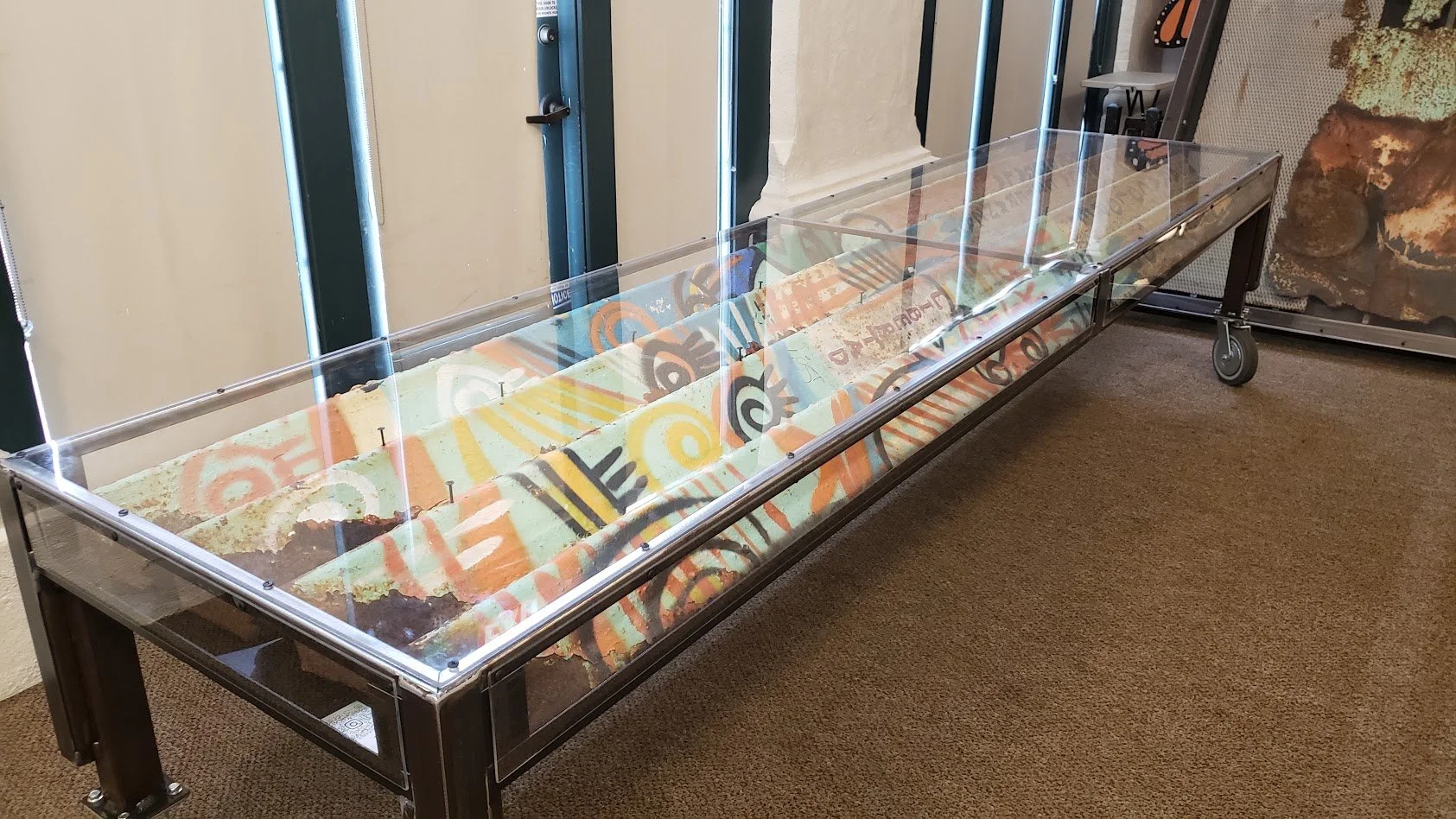
Traveling Table of Amistad
One of the tables contains wire mesh that once composed part of the border wall at Friendship Park. It is called "Pinky Kiss." Visitors who wanted to touch one another across the border were only able to do so only by touching their pinkies together through the mesh.
But touching pinkies across the border wall is no longer possible. Access to the border is severely restricted on the American side at Monument Mesa, where Friendship Park is located, and on the beach below.
On the mesa, Mexico and America are separated by two separate fences, both 30 feet high, and a no man's land in between. On the beach for a short stretch there is just a single fence that runs 300 feet out into the Pacific. Access to the fence, however, is restricted by the numerous Border Patrol agents in the area who will turn on their emergency lights if you even start approaching it. (Trust me, I've tried it.)
It had once been different.
In the exhibition film, you see Pat Nixon inaugurating International Friendship Park on August 18, 1971. You see her shaking hands over the border with a man on the Mexican side. At that time, all that existed as a border barrier was a waist-high barbed wire fence.
During the inaugural event, the First Lady crossed into Mexico and greeted Tijuana residents.
In her remarks at the ceremony, she said she hoped there would not be a fence “too long here" and that there would be a truly binational park on the site, but things didn't work out that way.
The militarization of the border didn't occur overnight, and it didn't begin with Trump. Operation Gatekeeper dramatically intensified enforcement and construction of physical barriers in the San Diego area in the 1990s, during the Clinton administration. That was followed by the post-9/11 expansion of border security under George W. Bush, by the record numbers of deportations under Obama, and by Trump's push to further militarize the border and extend physical barriers into places where none had existed before.
In Trump's second term, wall construction has accelerated dramatically. Environmental protections have increasingly been tossed aside and opportunities for cross-border contact have been snuffed out.
Against that backdrop, the Friends of International Friendship Park continues to pursue its long-term goal: a permanent international park on the beach at the border even though this vision seems unlikely to be realized anytime in the near future.
At the same time, however, the group is pursuing more modest goals, according to Rosa María Hernández, its executive director.
The current exhibition was one step towards the manifestation of those goals.
"We're hoping to educate and showcase what we are doing with the rest of the pieces," Hernández said about the exhibition. "We're looking to find a home."
That is, she's looking for a place featuring the preserved fence sections that could serve as a community gathering place.
Since the wall was replaced in 2023, the Friends of International Friendship Park have been in continual conversation with community leaders, which includes the Museum of Us, looking to partner with museums, civic spaces, and/or community spaces in order to faciltate this goal.
Dan Watman, the Friends' program manager, was also at the exhibition opening. I first met him at Playas—the Tijuana side of the border fence—in July, 2018.
I had gone south of the border just for the day, looking for a story to write, as the arts editor for NUVO, an Indianapolis-based alternative paper. (My parents live in La Jolla.) I was at the border fence, checking out the gardens of native plants that had been planted there when I ran into Watman, the man who had planted them.
He had started his work on the border more than a decade before.
"I got in at the beginning of the 2000s," said Watman, who had grown up in Modesto, California. "I was new to the area, and I had gone to Mexico and lived in Mexico for a while, and I moved to San Diego."
But Watman wanted to be in touch with his Mexican friends so he wound up coming back to Tijuana. Utimately, he found his way to the beach.
"I found the space where you could actually talk to people through the fence, so I would just go there all the time, and then I started trying to think of ways to get people to come together and make friends there."
He started planting gardens of native plants along the fence. He did so with friends on both sides of the border. He became the founder and coordinator of the Borderless Friendship Garden of Native Plants inside Friendship Park, supporting himself by teaching Spanish, while living in Tijuana.
But, after 9/11, the walls were already closing in. In 2006, the U.S. federal government began taking land by eminent domain from California. In 2009, Border Patrol began constructing walls that slashed right through the park.
Friends of International Friendship Park was formed in the wake of this takeover. They advocated for increased public access to the park on the American side not just for the binational Friendship Garden but for Americans who wanted to talk to family members and friends on the other side of the border wall.
Through the 2010s access became increasingly restricted not just for visitors at International Friendship Park, but for Watman and his fellow gardeners.
Ultimately, in 2020, the gardens on the American side were bulldozed by Border Patrol.
The first time I visited Playas de Tijuana, I was struck by how festive the atmosphere was in comparison to the beach on the American side. On the beach, I saw professional players practicing soccer (fútbol) with their coaches and families picnicking. On the boardwalk, I saw vendors selling all kinds of street food including squid on a stick. Nearby, men were working out at an outdoor gym.
Looking through the posts to the American side, the contrast was striking. I saw a sad and desolate beach, populated by Border Patrol agents and their vehicles. In the 11 years since I first visited Playas, I've seen the American side of the border become more and more militarized, while the Mexican side remains as open as ever.
Some of Mexico's finest muralists have been involved in painting the brand new border wall—now 30 feet high—making it seem less intimidating.
And right along the Mexican side of the border fence, the gardens that were started twenty years ago are still being cared for by Watman and his friends.
When I revisited them later in the day, Watman and Hernández were hosting a workshop at the Museum on identifying and overcoming social divisions through community dialogue. It seemed apropos that the participants sat around the Traveling Tables of Amistad—which means friendship.
The eight participants from different areas of San Diego: Normal Heights, El Cajon, Rancho Bernardo among them.
I joined in.
With Watman's guidance, we workshopped and identified problems in our communities: social stratification, and homelessness among them. The goals for overcoming social divisitions ultimately involved focusing attention away from massive infrastructure projects like California High-Speed Rail, according to one participant. This seemed in-line with the group consensus. There was also agreement that concentrating attention on local affairs, with hands-on involvement from community members, is the path forward for concerned citizens in a time when the border has become the defining symbol of American life.
This also seemed in line with Watman's goals, and those of Friends of International Friendship Park.
"We want to have a space where people have a chance to get to know each other and make friends and see if that actually contributes to security," he said.
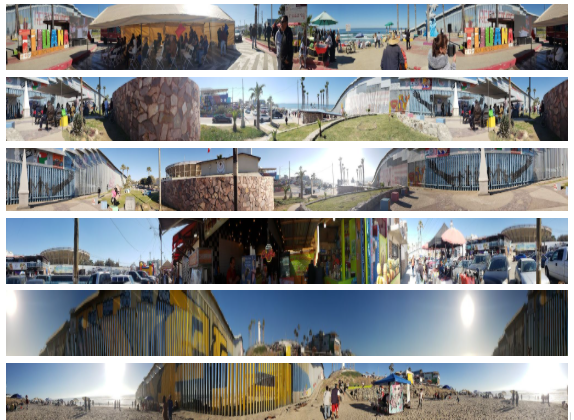
Panoramic images of Playas de Tijuana
From the exhibit promotional material:
Exhibit Dates
Closing: September 19, 2026
Hours: Daily, 10 a.m. – 5 p.m.
Interactive Workshops:
Free, 90‑minute workshops led by Friends of International Friendship Park Program Director Dan Watman will be held on select dates during the exhibit. No registration is required, and they are included with Museum admission
Workshop dates & times:(remaining dates):
September 13, 2026 – 2:00 p.m.
September 19, 2026 – 2:00 p.m.