Tea at the Fence: With Pedro Ríos at the Border

Pedro Ríos at the solidarity station at Whiskey 8 open air detention site on the US-Mexico border
Tea at the Fence: With Pedro Ríos at the BorderNote: A year ago today, I met Pedro Ríos at a solidarity aid station on the US-Mexico border operated by the American Friends Service Committee. Since that time, the aid station has been dismantled, and the Trump mass deportation program has moved forward on an industrial scale. As has been said before, by other writers in other venues, the border is no longer just at the border. The border is everywhere.
On the night of February 11, 2024, I met Pedro Ríos two miles west of the San Ysidro Port of Entry, inside a soft-sided tent pitched alongside the U.S.–Mexico border wall in South San Diego. The tent served as an aid station run by the American Friends Service Committee (AFSC).
The wall here is doubled: a 30-foot-high secondary fence on the U.S. side, and, one hundred meters south, a parallel primary fence of equal height running along Mexico’s Highway 2. Between them lies a narrow, windswept corridor that Border Patrol calls Whiskey-8. Migrants who enter it are considered arrested—but not yet processed—and may be held for hours before being transported away.
From the tent, the highway in Tijuana curves west toward the coast. On the US side, Border Patrol vehicles idle nearby, their presence constant.
Inside the tent, Ríos, who has directed AFSC’s border program for the last 20 years, heated water on a small gas stove. We poured tea and sat on folding chairs, waiting to see if anyone would arrive at the fence. That night, no one did. The quiet felt strange, considering that the Trump 2.0 mass deportation program was gearing up all around us.
Since September 2023, volunteers at this solidarity aid station had passed water, food, medical supplies, dry clothes, and phone chargers through the four-inch gaps between fence bollards—just wide enough to pass a bottle or a hand. At earlier moments, hundreds of people might have appeared at once. Lately, appearances at Whiskey 8 had become increasingly rare.
Ríos, 52, knows this terrain intimately. Born and raised in South San Diego, he has watched the border harden over decades. He told me about a nearby stretch of border known informally as “the soccer field”—a place where migrants ran and Border Patrol chased under cover of darkness, and he told me about how the border had hardened, become militarized, over the past 30 years.
His path into border work began in the mid-1990s during California’s Proposition 187 campaign, which sought to turn teachers, doctors, and social workers into immigration cops. The measure was ultimately blocked by the courts, but it pointed Rios towards wanting to be active in the community, working on immigrant rights issues.
“I started doing that as a student at the university that I was attending, and then eventually, when I graduated, I moved to the Bay Area,” he told me, “And I was able to continue that work, first as a volunteer, then in a professional setting. While I was in the Bay Area, I also integrated myself into a master's program, and the degree I received was focused on immigration advocacy and immigration rights. Then when I returned to San Diego, I was fortunate enough to find a job with the American Friends Service Committee.”
For Ríos, it led from student organizing to graduate study, and eventually back to San Diego and AFSC, whose border program has operated continuously since 1977.
AFSC’s Border program, which extended well beyond the fence. In addition to humanitarian aid, the organization conducted legal education workshops, Know Your Rights training, and advocacy with local, state, and federal agencies. In recent years, requests for these presentations have surged as fear has spread through immigrant communities.
The small red cards now common in neighborhoods like Barrio Logan—cards instructing people how to assert their constitutional rights during encounters with law enforcement—were part of this ecosystem. They were small, and perhaps dubious, comfort, considering that various principals of the Trump administration had already made noises about disrespecting the courts’ constitutional authority.
The work at Whiskey-8 existed in a legal gray zone. Volunteers operated on federal land without formal permission, tolerated by local Border Patrol. At times, Border Patrol agents had photographed volunteers and license plates, for what purpose Rios didn’t know exactly. But it highlighted the fact that AFSC could’ve been removed at any time. That it hadn’t happened, Ríos believed, may have been due to public scrutiny—and to documentation of Border Patrol’s own failures to meet basic detention standards.
For Ríos, the big question was when custody begins. Border Patrol maintained that migrants were not in custody until they were transported away from Whiskey-8 to a more formal detention facility. Ríos disagreed. He has seen agents instruct people where to sit, forbid them from moving, and require them to remove shoelaces. To him, those are unmistakable signs of control and authority.
The consequences were not abstract. He recalled people arriving with broken ankles, deep cuts from concertina wire, dehydration, head injuries. A Jamaican father whose young daughter fell from the wall and struck her head. Only after persistent advocacy did Border Patrol agree to call an ambulance.
“I sincerely believe the volunteers here have saved people’s lives,” Ríos told me.
He also believes the work shouldn’t have been necessary. Border Patrol had a poor track record at Whiskey 8 caring for people under their authority. They had installed a large water tank in the area but provided no cups, for example, no signage indicating the water was safe to drink.
“I would like to see us not be here,” he said. In a month’s time he would get his wish, because few, if any, migrants were showing up anymore at Whiskey 8 to seek help. Within a few months, AFSC would abandon this site altogether not because the migrant issue had vanished, but because the war on migrants had shifted to other arenas.
As we talked, the kettle cooled. The traffic continued to move on Federal Highway 2 directly to our south.
We talked about other things—how I was helping my dad care for my mom, our shared interest in photography. I told him I was still shooting with a Galaxy S9 from 2019, and felt oddly proud of it. He smiled as he one-upped me: his phone dated to 2015.
Sharing tea in the tent felt surreal.
What I wanted that night was simple: to talk with someone who knew what was happening on the border. Rios gave me a good idea I think, but it was still early days, less than a month into the second term of the Trump administration. But my response wasn’t only journalistic:
Border Panoramics
I was taking panoramic photos at the border.
at night, aiming the camera at the 30-ft-high
fence bollards migrants still try
to climb. A Border Patrol agent looked down
from his post, puzzled
by my movements. If I captured
the agent in my frame and rotated
more than 360°, I might catch him at two points
in time—his expression of concern turning
to indifference. Standing here long enough,
day and night might collapse into
one frame. But the border will not collapse.
The more I widen the lens,
the tighter the wall encircles itself around me.
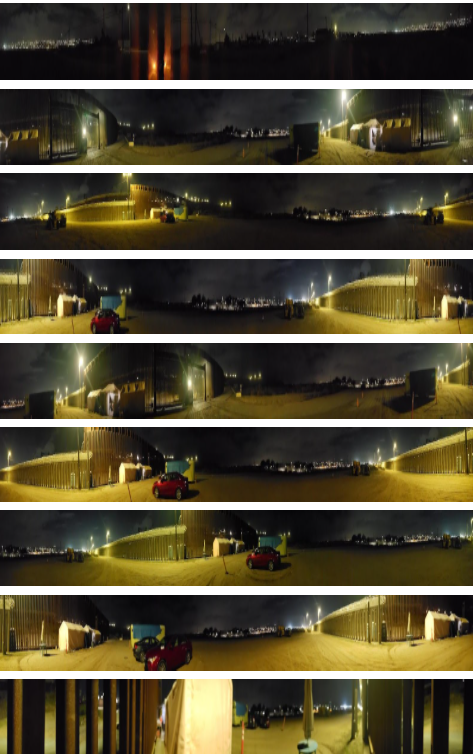
Panoramic shots of secondary border fence around Whiskey 8