Gravity’s Rainbow at Otay Mesa Detention Center: Orwell, Eclipsed
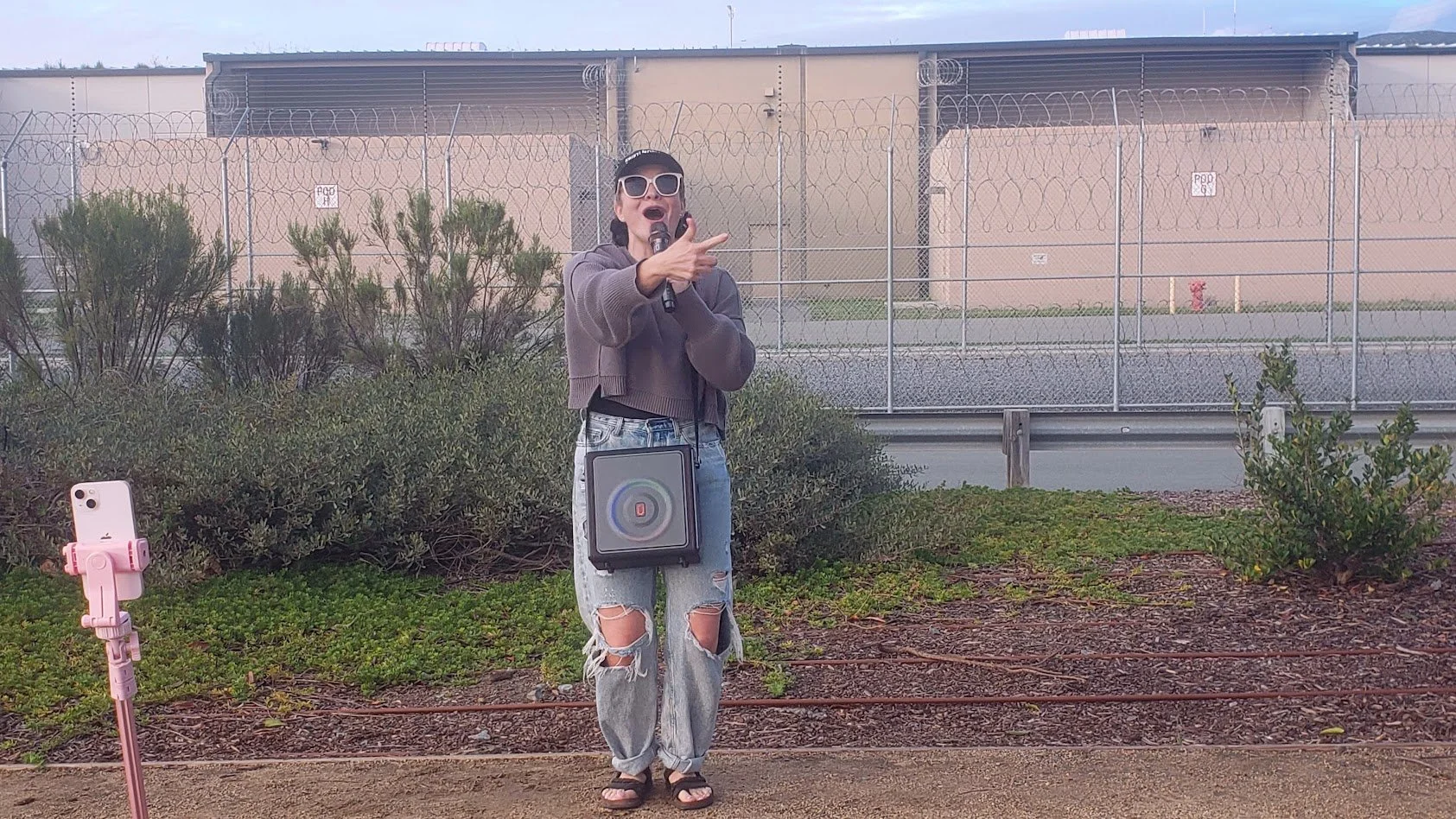
Chelsea Gods singing “Kristi Noem is a Bird-Legged Ho” in front of the Otay Mesa Detention Center
The most troubling thing about the shooting of Renée Nicole Good in Minneapolis by an ICE agent wasn’t merely that it appeared, at first glance, to be a summary execution. After multiple viewings of the available video, it still does. What was more disturbing was the response that followed. Only hours later, “ICE Barbie” stated that the agent had followed his training when he shot Good three times at point-blank range and then left her for dead, fleeing the scene.
“ICE Barbie,” of course, is Secretary of Homeland Security Kristi Noem.
Not long afterward, Donald Trump posted on Truth Social that Good had “violently, willfully, and viciously run over the ICE officer,” who “seemed to have shot her in self-defense.”
Justin Amash, the former Republican congressman, was one of many who likened the official response to George Orwell’s 1984, posting this quote on Twitter: “The Party told you to reject the evidence of your eyes and ears. It was their final, most essential command.”
Orwell’s novel centers on Winston Smith, whose act of rebellion consists of little more than thinking independently—keeping a diary, and carrying on an affair with a young woman named Julia—before the state crushes him.
I suspect that quote is going viral because the evidence, of a callous and short-tempered agent hell bent on homicide, is right there on the videos. The usual talking heads on the major networks urge caution, insisting there should be no rush to judgment and calling for an FBI investigation—from which the state of Minnesota will be excluded. But given that Noem and Trump have already all but exonerated the agent, it is difficult to imagine the federal investigation reaching a different conclusion.
That an ICE agent chose to kill her, and that MAGA immediately set about manufacturing a narrative in his defense, is the point at which Orwell begins to feel insufficient.
Orwell still explains much: the rejection of empirical reality; the inflation and conflation of real and imagined enemies; the degradation and conflation of language (“fake news,” “narco-terrorists,” and the like). But Orwell did not envision a world in which an adjudicated rapist president would be treated by his followers as a quasi-messianic figure—one whose reality-show sermons consist of an endless litany of grievances rooted in resentment-driven identity politics, peppered with threats and insults endlessly recycled on social media. Nor did he imagine the trolls, both online and off, including Vice President J.D. Vance, who accused Good—a mother of three and a poet—of being a terrorist and therefore responsible for her own death.
Enter Thomas Pynchon.
Unlike Orwell, who was a journalist with a substantial public presence, Pynchon is famously reclusive—famous, perhaps, for his absence. The last unequivocally verified photograph of him dates back to his 1953 high school yearbook. Reading his novels, particularly Gravity’s Rainbow, one begins to suspect why he has remained hidden ever since.
That is, Gravity’s Rainbow is saturated with paranoia. The novel, published in 1973, follows the adventures of Tyrone Slothrop, an American Army lieutenant stationed in London during World War II. Slothrop’s peculiar talent is that he experiences erections in advance of V-2 rocket strikes. Once this ability becomes known, the authorities tasked with tracking rockets across Europe grow increasingly interested in tracking him. The arc of the novel is a sexually charged, multiparty conspiracy to unite the V-2 rocket with the atomic bomb.
Where Orwell gives us a single oppressor—the Party—what Pynchon gives us is more diffuse and unsettling. In his world, power does not simply impose itself; it fragments reality. Truth does not vanish so much as it splinters into competing plots, overlapping systems, and mutually reinforcing delusions. No one is ever fully in charge, or if someone is, their authority is obscured by layers of intermediaries, contractors, proxies, and noise. Paranoia, in Pynchon, is not a pathology but a rational response to opaque systems whose inner workings are deliberately hidden. Censorship gives way to overload. Instead of silence, there is too much information—so much of it contradictory, synthetic, or weaponized that meaning itself becomes unstable. Think of a rocket you hear before you understand who launched it, or why.
This is why 2026 feels less Orwellian than Pynchonian. There is no single Party demanding obedience, but a swarm of actors operating simultaneously: state agencies and “former” officials still pulling strings; private contractors and prison corporations; tech platforms that algorithmically amplify grievance; militias and influencers competing for attention; shadow donors underwriting chaos; AI-generated voices laundering authority through simulation; bro-casters hustling strawman arguments. Conspiracy no longer coheres around one master plot. There are too many conspiracies, intersecting and diverging, none of them fully provable, all of them plausibly deniable. Over all reigns a shifting roster of teflon authority figures—from the Border Patrol’s Gregory Bovino all the way up to Elon Musk and Donald Trump—that make accountability feel quaint. In such a landscape, disbelief is exhausting, belief is reckless, and suspicion becomes the only stable posture.
I read Gravity’s Rainbow once, and only once, at eighteen, during the summer before I left for college. It wasn’t my first encounter with Pynchon. That was The Crying of Lot 49, the story of Oedipa Maas, a young housewife who uncovers a centuries-long dispute between rival mail-delivery systems, aided by Genghis Cohen, the most renowned philatelist in Los Angeles. The conspiracy unwinds like a Möbius strip. Like Gravity’s Rainbow, Crying is steeped in paranoia, but it is a sunnier novel—published in 1966, set in Southern California and the Bay Area, and leavened with slapstick encounters involving neo-Nazi surfer dudes, Oedipa’s husband Mucho Maas (a radio DJ and former used-car salesman increasingly strung out on LSD), and the Paranoids, a tiny rock band aping the Beatles. At just under 46,000 words, it remains my recommendation for anyone curious about Pynchon.
Pynchon is not for everyone. Many readers find his prose dense and disorienting, full of digressions and sentences that sprawl across entire paragraphs. I once encountered a YouTube video in which someone ranked Pynchon’s novels without having read Gravity’s Rainbow—a parody of authority that might itself be called Pynchonesque. I’m not entirely unsympathetic. I’ve struggled with Pynchon myself more recently.
The last novel of his I read was Vineland (1990), which revolves around Zoyd Wheeler, a former hippie, and Brock Vond, a federal agent bent on destroying both Zoyd and the People’s Republic of Rock and Roll, a breakaway nation of dope smokers in Southern California. The plot is extraordinarily complex, made more so by Pynchon’s convoluted syntax and indica-haze narration. My difficulty following it may owe as much to what Nicholas Carr documents in The Shallows: What the Internet Is Doing to Our Brains as to the book itself. My attention span is not what it once was.
One sentence I underlined—the ponderings of a federal drug enforcement agent named Hector Zuniga—seemed to project itself thirty-five years into the Trumpian future:
Was Reagan about to invade Nicaragua at last, getting the home front all nailed down, ready to process folks by the tens of thousands into detention, arm local “Defense Forces,” fire everybody in the Army and then deputize them in order to get around the Posse Comitatus Act?
For those who find Pynchon’s prose daunting but want a taste of the Pynchonesque, I recommend the recent film by Paul Thomas Anderson, One Battle After Another, loosely based on Vineland but transposed into the twenty-first century. Zoyd becomes “Ghetto” Pat Calhoun (Leonardo DiCaprio), whose relationship with Charlene (Chase Infiniti), the girl he raised as his daughter, gives the film its emotional core. Brock Vond reemerges as Stephen J. Lockjaw (Sean Penn), now drawn to the white supremacist group known as the Christmas Adventurers that wields power behind the scenes in federal law enforcement circles. Vond’s plans are complicated by the fact that Charlene is his biological daughter—and half Black.
The plot is more elaborate than this summary allows, but worth noting is the opening scene, in which “Ghetto” Pat participates in the liberation of migrants from a detention facility in Otay Mesa, San Diego. Lockjaw appears as the commander of that facility.
I saw the film on opening day in San Diego. Not only was it shot near Otay Mesa, but a real detention facility exists there: the Otay Mesa Detention Center, where migrants are warehoused. When I visited for the first time, three weeks later, on October 29, 2025, I was struck by how much larger it was than the temporary set used in the film. The center spans roughly forty acres—about the size of the nearby Amazon fulfillment centers and sort facilities.
As I arrived, immigrant rights activists were setting up a Día de los Muertos altar outside the facility. Traditionally, such altars honor deceased relatives. This one commemorated the twenty-one migrants who had died in ICE custody that year. Each name was written on a placard above a flickering candle and a painted monarch butterfly, the symbol of migration. The vigil was organized by Friends of Friendship Park, along with the American Friends Service Committee, Detention Resistance, and Free Them All San Diego. About thirty people attended, assembling the altar as security guards watched from the edge of the property.
When I returned during one of the regular Sunday vigils on January 5, 2026, the atmosphere was very different. Chelsea Gods, a comedian and social media personality, was there, along with activist and influencer Arturo Gonzalez. Shortly after I arrived, Gods launched into her song “Kristi Noem Is a Bird-Legged Ho,” chanting through a megaphone while wearing a baseball cap emblazoned with the lyric, performing for a crowd of about thirty activists.
I knew Gonzalez only from his videos, in which he follows ICE agents and Border Patrol officers around San Diego County, shouting “¡La Migra!” to alert nearby residents and workers, and confronting agents directly, telling them to get the fuck out of wherever they were. He told me his car had recently been impounded after he was accused of driving erratically, but that friends were helping him get around.
Nearby, activists waved anti-Trump signs as workers for CoreCivic—the second-largest private prison operator in the United States—drove in and out of the sprawling parking lot. As of late 2025, CoreCivic’s total annual revenue exceeded $2 billion, buoyed by expanded federal contracts under the Trump administration.
CoreCivic staff were acutely aware of the activists’ presence. Every ten minutes or so, a CoreCivic truck cruised the perimeter road, prompting Chelsea Gods to lead chants mocking the driver’s appearance. One white-haired man with a mustache was dubbed “Grandpa” and asked whether he was proud of himself. He stopped, said something about a “violation,” laughed it off, and drove away. A younger man later emerged from the detention center carrying a pole, poking at the ground. He appeared to be searching for notes detainees had attempted to throw over the pod walls—written communication being expressly forbidden. The pods were labeled alphabetically on the outside of the massive facility. The man wore his hair in a bun, provoking jeers of “man bun” from the crowd.
The scene reminded me of the Counterforce in Gravity’s Rainbow—Pynchon’s term for resistance to the corporatists trying to unite rocket and bomb, embodied by Slothrop and others through acts of obscenity, mockery, and bodily rebellion, including an infamous episode of chain-vomiting induced during a grotesque corporate meal.
But the activists were there for a far more serious purpose: to communicate with detainees. Occasionally, voices carried over the pod walls. Activists recorded responses in multiple languages, trying to make contact with families on the outside.
San Diego activist Jeane “Blue” Wong spoke to that mission. While we were there, she said, she was receiving real-time messages from women in Pod G behind us. One of them, Liliana, wanted help telling her story, Wong said. She had fled political violence, wanted to make it in America, and those dreams were now in jeopardy.
Wong encouraged people to return the following week to continue the call-and-response exchanges—shouting back and forth to obtain detainees’ A-numbers, the alien registration numbers that function as case numbers within the immigration system.
I asked Wong who I might contact about a situation at my parents’ home in La Jolla. I told her about Nathalie J., the caregiver who helped my disabled, sundowning mother maintain her sweetness under strain. “I’m your friend, Nathalie,” she would tell her, again and again. Nathalie was Haitian. We spoke French; she taught me Creole. She was young, ambitious, and beautiful, and I looked forward to her shifts at my parents’ house.
One night in late October 2025, she didn’t show up. The agency later said they couldn’t reach her. Fearing the worst, I entered her name into ICE’s online detainee locator. It showed her, or someone with her name, detained at Otay Mesa.
Wong said it would be difficult, at best, to get information, but she referred me to another activist who took my name and promised to follow up. Maybe, in my dreams, I could raid the Detention Center and bring down its walls alongside Leonardo DiCaprio. In this world, outreach was all I could do.