A dispatch from San Diego Immigration Court: the calm in the eye of the storm
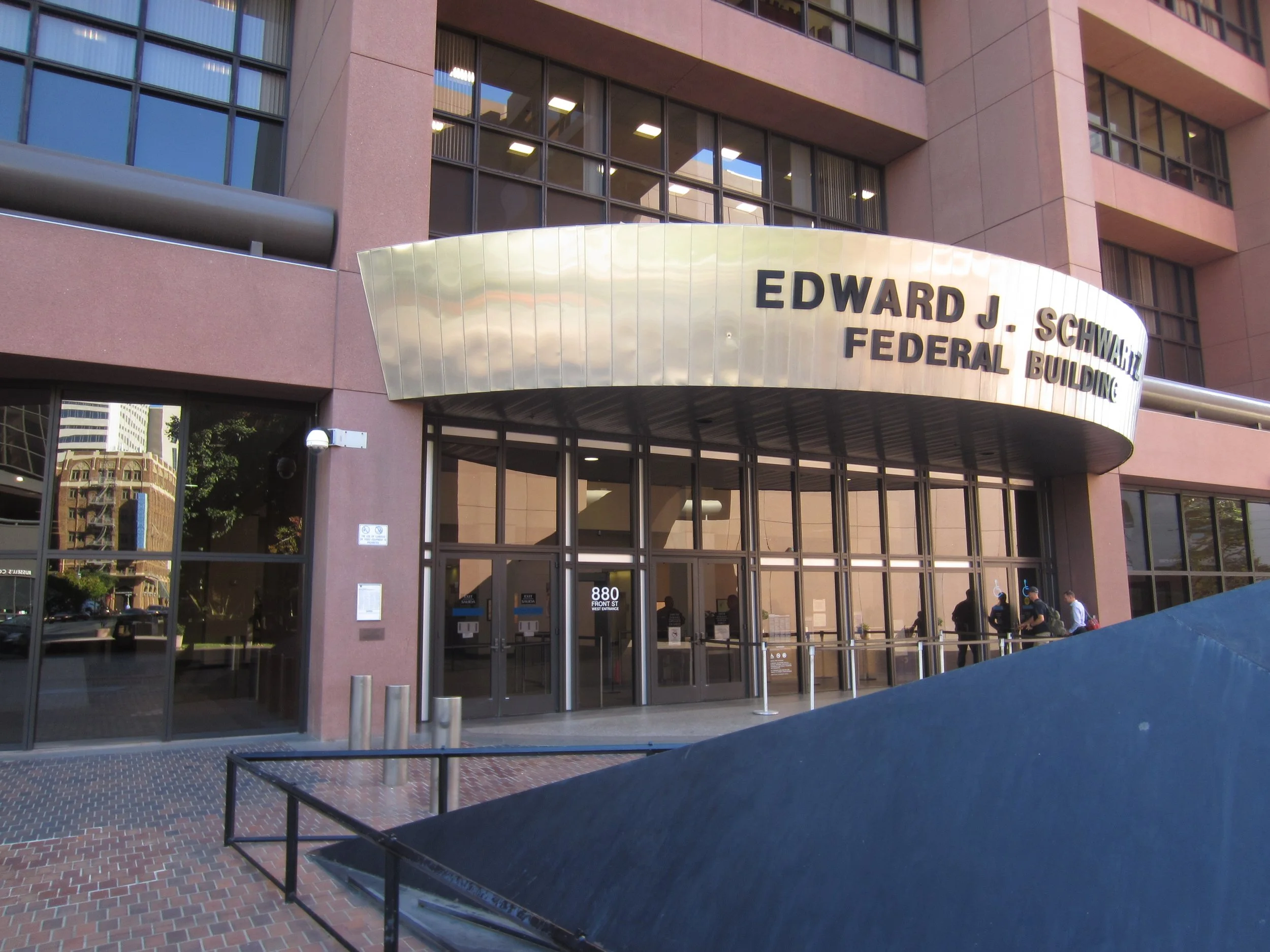
Attribution: Another Believer, CC BY-SA 4.0 <https://creativecommons.org/licenses/by-sa/4.0>, via Wikimedia Commons
A dispatch from San Diego Immigration Court: the calm in the eye of the storm
-By Dan Grossman
The government was still shut down on November 5, 2025, but the immigration court in San Diego was open. Once I stepped into the master calendar hearing, in Courtroom #1 on the fourth floor of the Edward J. Schwartz Federal Building, I didn’t step out again for two and a half hours. In these hearings, dates for future proceedings are set; the judge checks with both the government’s counsel and the immigrant’s attorney to confirm that all necessary paperwork has been filed, fees paid, biometrics completed.
On the surface, nothing appeared out of the ordinary. Judge Scott Simpson was unfailingly polite, relaying that politeness through his Spanish interpreter seated to his left. The attorney representing the Department of Homeland Security was even-tempered, and the immigration attorneys were well-prepared. The respondents were cooperative. I sat on a wood bench in the gallery with about 30 respondents, lawyers, and activists. I observed eight cases. One woman appeared with her daughter, accompanied by her attorney. Several men appeared without counsel. There were no disruptions, no evidence of Immigration and Customs Enforcement (ICE) waiting outside the courtroom doors. Elsewhere, the Trump administration’s brutally effective immigration policy, dedicated to removing as many immigrants as possible, as quickly as possible, continued to run roughshod over the Constitution’s protections for due process. But here it felt like the calm in the eye of the storm.
In a couple of cases, final removal seemed imminent, with the respondents asked by the judge whether they had a preferred country of deportation. The respondents said they did not. Yet in both cases, when asked if they had a credible fear of returning to their home countries, they said yes. In some other cases, the required fees had not been paid. At one point Judge Simpson referenced the “Big Beautiful Bill” passed by Congress, which had the effect of raising fees for several migrants who had not yet paid them, either because they lacked the money or because the payment system had come online only recently.
A little while later, a burly, bald Portuguese man named José, who didn’t speak English and had no attorney, explained through the translator that he hadn’t yet completed his submission of biometric information, required for an asylum application. Judge Simpson took that opportunity to note—through the interpreter on a conference call phone system—that José had entered the United States at a time, presumably under the Biden administration, when those crossing between ports of entry were not deported immediately after being detained by Border Patrol.
“You came at a time when that didn’t actually happen,” he told him.
But it was the first case I observed, the case of Ángel, a seemingly shy man with a mustache, that revealed how current immigration law functions as a kind of meat grinder. Through his attorney, I learned he was not as young as he looked; he had a nine-year-old child. I also learned he had no convictions since his case was administratively closed. The fact that he was back in court meant the case had since been reopened.
Outside the courtroom, I met a volunteer with Detention Resistance, an organization whose mission was to end detention and “make visible the human rights abuses at prisons.” The retirement-age woman, who preferred not to give her name, told me the biggest shift she’d seen recently at master calendar hearings—the only hearings open to the public— was the large number of administratively closed cases now being hauled back onto the docket.
She was not the only volunteer in the gallery. Also present were members of FAITH, the accompaniment group organized by Our Lady of Guadalupe Catholic Church, the San Diego Diocese, and the San Diego Organizing Project, which describes itself as “an ecumenical ministry grounded in bearing witness, building trust, and providing pastoral care for individuals and families during their immigration court hearing.”
One FAITH volunteer told me she hadn’t seen ICE agents outside the courtrooms in months, though she suspected that immigrants with open cases were still being detained quite often—just out of view of the press and of human-rights observers. Which just might have something to do with the fact that 70 percent of migrants are now skipping immigration hearings.
Court-watch groups in New York City, similar to FAITH and Detention Resistance, have had their Signal chats surveilled by the FBI. Meanwhile, over the past months, the administration has fired large numbers of immigration judges—including dozens nationwide and around a third of the bench in San Francisco alone. (According to an analysis by the San Francisco Chronicle, judges with high asylum-grant rates have been targeted by Trump officials.) Considering the Trump administration’s focus on expediting removals, it’s not surprising that a third of immigrants don’t even show up for hearings at San Diego Immigration Court.
Walking out into the afternoon sunlight, it seemed the government hadn’t shut down at all—not the parts designed for maximum control of its population. Inside, the calm I’d witnessed earlier now felt less like reassurance than the deceptive stillness at the center of a storm. The pressure had been building all along, held in place by polite voices and orderly procedure, but the larger system was still churning just beyond the courthouse walls—winds gathering, drawing people in and stripping them of protections with a force you could sense only by standing in its path. What looked momentarily quiet from the gallery was only the brief pause before the storm’s outer bands closed in again.