Out to Lunch in San Diego: Spanish, Translation, and Emily Wilson’s New Book
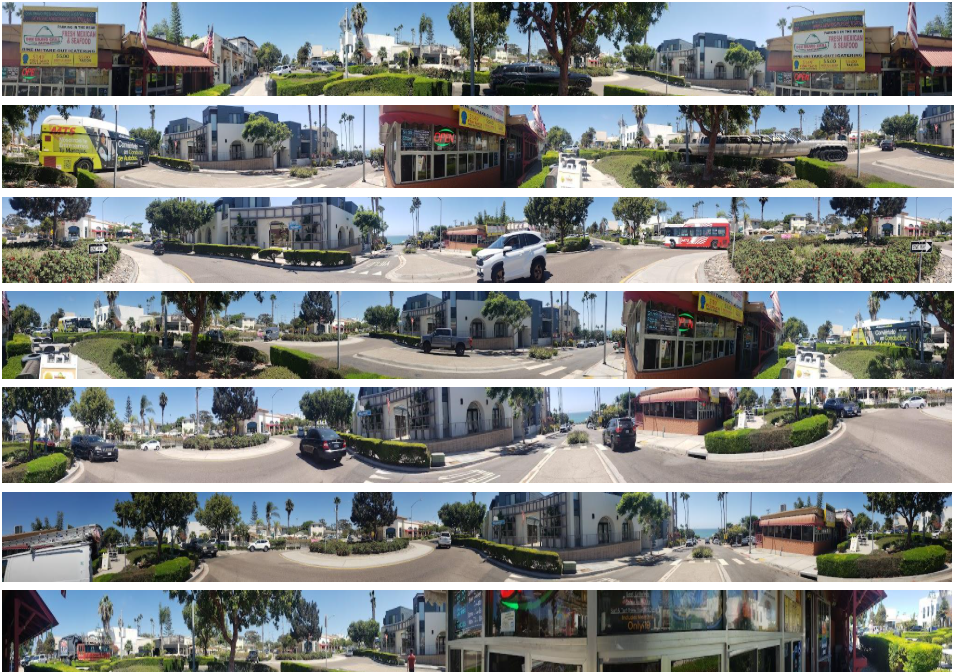
Panoramic images taken in Bird Rock, San Diego by Dan Grossman
Yesterday, I did a little grocery shopping at Trader Joe’s and Gelson’s in Pacific Beach, San Diego. Both stores are very close to my parents’ house where I’m helping my parents, which is pretty much a full-time job, and I usually have to be close at hand.
I was after items not to be found in La Jolla: I wanted some vegetarian Indian cuisine frozen options (Trader Joe’s) and Bubbie’s kosher pickles, which are hard to find in La Jolla, which I was getting for my dad. On the way back, I figured I’d try the $1.50 fish taco at Don Bravo’s, a small Mexican grill in Bird Rock. It turned out to be a good choice, for both the food and the interior ambience. I read the title poem in my dog-eared copy of Roberto Bolaño’s poetry collection, The Romantic Dogs, which centers on youth and the passage of time, and I read it for maybe the 100th time. This particular edition is a facing-page translation written originally in Spanish and translated by Laura Healy and reading it in Spanish gives me the opportunity to work on my Spanish and read one of my favorite poets at the same time.
My Spanish language self-teaching isn’t going as well as I’d like as I have so many other projects going on (including an upcoming publication in Mirror Indy about the linguistic adjustments nonprofit administrators are having to make in Trump 2.0) but when I butcher a Spanish phrase when buying shrimp at Northgate Market or make some other horrible faux pas, I just recall the language learning advice given to me by a taxi driver in Tecate, Baja. “Despacio,” he said, meaning slow. Now, he was probably talking about the jumble of Spanish words coming out of my mouth in no good order, but it’s good advice for a language learner to be a turtle and not a rabbit, as it were.
There’s nothing wrong with going slowly—there’s nothing wrong with going over the basics over and over—and nothing wrong with taking your time, learning at your own pace. (Never mind the fact that by the time I get fluent I’ll probably be six-feet-under.) Speaking slowly, of course, also helps, and not worrying so much about the correct accent, but paying at least some attention to intonation which I think is exponentially more important.
After lunch, I took the panoramic photos you see above, waiting for the MTS bus to pass, so I can capture it twice in one frame, so I can capture it twice at two distinct moments in time. I have a book of such images, along with facing-page prose and poetry, titled American Panoramas Beyond 360° Poetry, Prose and Photography, available in color, black and white, and landscape editions. The photos I’m taking now are megapixel rich, and I’m planning to work with a printer to see how large I can blow up these images.
Later in the day, I picked up a book at the local bookstore Warwick’s, a book I’ve been waiting a while for, titled Crossing the Wine-Dark Sea: Journeys through Ancient Literature by Emily Wilson. I read the intro while waiting for half-price chicken tacos—half price anything is a rarity in La Jolla—at Taco Time, it being Taco Tuesday. “How can we imagine the ancients,” she writes, in all their strangeness and strange familiarity?” Wilson is the University of Pennsylvania classicist and translator of Homer’s The Odyssey who earned some extra notoriety for her jaundiced take on Christopher Nolan’s motion picture The Odyssey, describing it as “grand and superficial” lacking ethical, emotional, and political depth. I have yet to see this movie, and I haven’t read The Odyssey since middle school, but it’s been a while since I’ve read any Greek heroic epics. I’m more interested these days in the Romans, at least when it comes to poetry, particularly when it comes to Catullus, who Wilson writes about in her book.
I’m interested in what Wilson will have to say about the horrible Victorian-era translations of his work that scrub out any sexual or scatological references and paper them over with their overly ornate and flowery verse which I find nauseating. (Catullus is one of my favorites, and when I taught English composition at Marian University, I introduced my classes with his treatment of time in his poem #1. )
I’d also be very interested in Emily Wilson’s reaction to my poem about Roman emperor Caligula in a poem that I published on Substack the other day, a poem MY OTHER SISTER took exception too, because of a word in the poem that I used, a word she didn’t like, a word she thought many of my readers wouldn’t like. To oblige her, I edited several words out of my poem, this rendering of it anyway, so you DEAR READER can replace those words with anything YOU like.