Giants: Art from the Dean Collection at Newfields
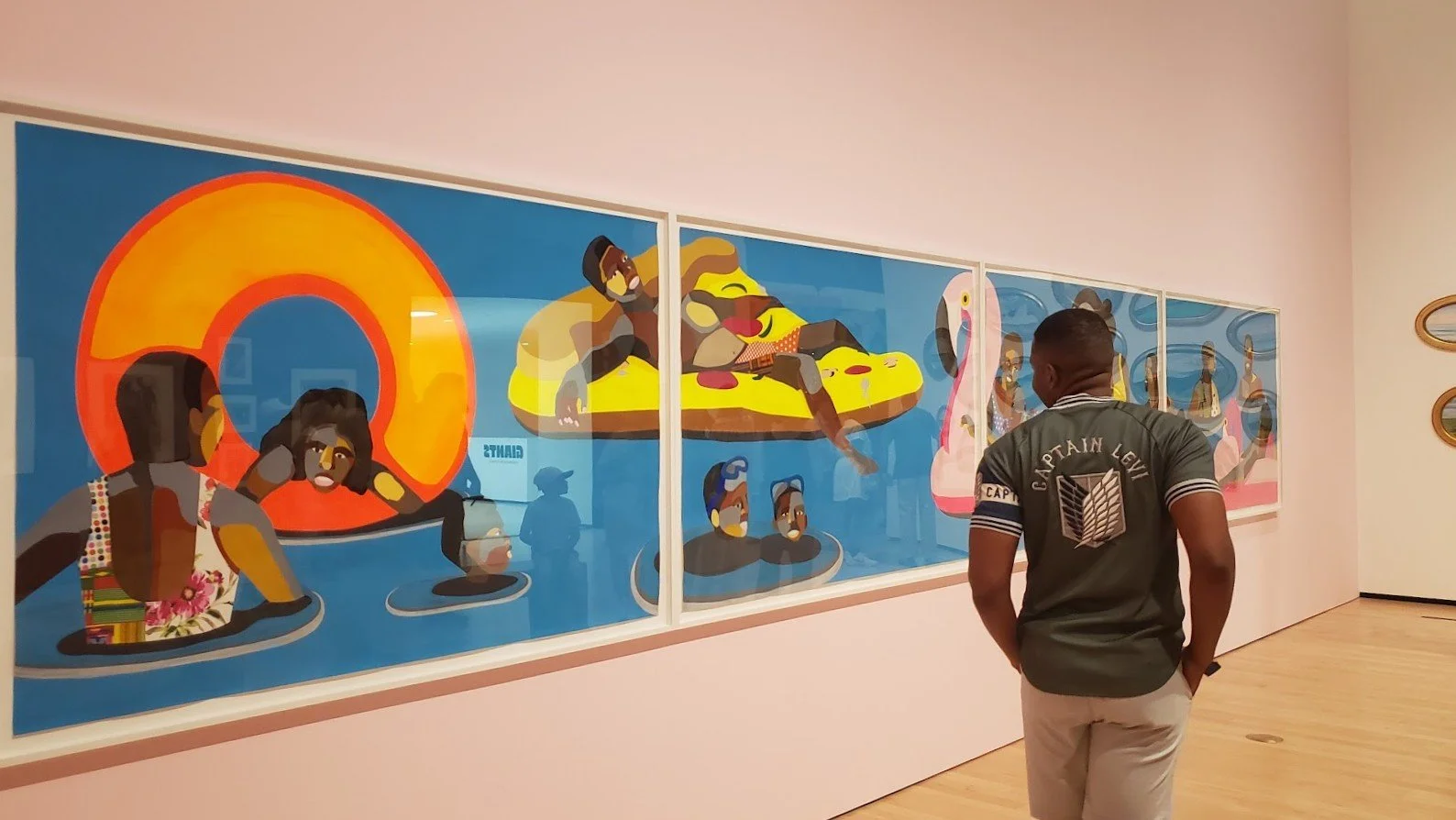
“Floaters” by Derrick Adams
I went to see Giants: Art from the Dean Collection of Swiss Beatz and Alicia Keys— yes, that Alicia Keys—at the Museum of Contemporary Art San Diego (MCASD) on its closing night, August 9.
Its opening day at Newfields was September 19.
I can’t tell you exactly what items are on display—I assume many of them will also be on display in Indy—but I can tell you about some of the art I saw there.
Keys and Beatz (Kasseem Daoud Dean), who are married and live in San Diego, employ the motto, “By the artists, for the artists, with the people” and they reportedly try to run their collection according to that motto in terms of helping their artists benefit from their art economically.
The artists in this exhibition are mostly, if not all, Black; including African artists, African American artists, and artists from elsewhere in the diaspora. While the exhibition isn’t necessarily political—unless raising awareness of the creativity within Black communities is political—it nevertheless intersects with politics.
Consider that the artist who painted the large portraits of Beatz and Keys, Kehinde Wiley, was in the news lately because his painting “Young Artists After Siamesas 1960” was removed from the US Embassy in the Dominican Republic for being too woke for the Trump administration, according to the New York Times. Wiley is probably best known for his portrait of Barack Obama.
Knowing this, it’s difficult not to see the exhibition through a political lens, especially in the selection of exhibited works which engage politics and history, and the intersection of both.
It’s hard to think of a photographer more connected to the Civil Rights Movement than Gordon Parks, for example. Included in the “On the Shoulders of Giants” section, acknowledging his place in a lineage of artists who have shaped contemporary arts and culture, is a generous selection of his black and white prints.
This section also includes paintings by Esther Mahlangu, arguably South Africa’s best known visual artist who has adapted the traditional decorative art of the Ndebele people.
In her work, I was reminded of the geometric designs that Hausa villagers carved into their mud brick walls in Niger, West Africa. (I served as a Peace Corps volunteer from 1992-1994). But her large and colorful painting “Ndebele Abstract” wouldn’t seem at all out of place in an exhibit of work by artists, say, like Ellsworth Kelly or Mark Rothko.
Elsewhere, abstraction serves a more overtly political purpose, such as Hank Williams Thomas’ “You Shouldn’t Be the Prisoner of Your Own Ideas” a quilt-based canvas made from old prisoner uniforms, a quilt that at once acknowledges the quilting tradition in the American South and the history of mass incarceration in the United States. It’s work that might just remind you of that of Samuel Levi Jones’ exhibition Left of Center at Newfields in 2019, where Jones displayed wall-hanging canvases made out of deconstructed institutional books, tagging the history of systemic racism in the US in the titles and the exhibition wall text.
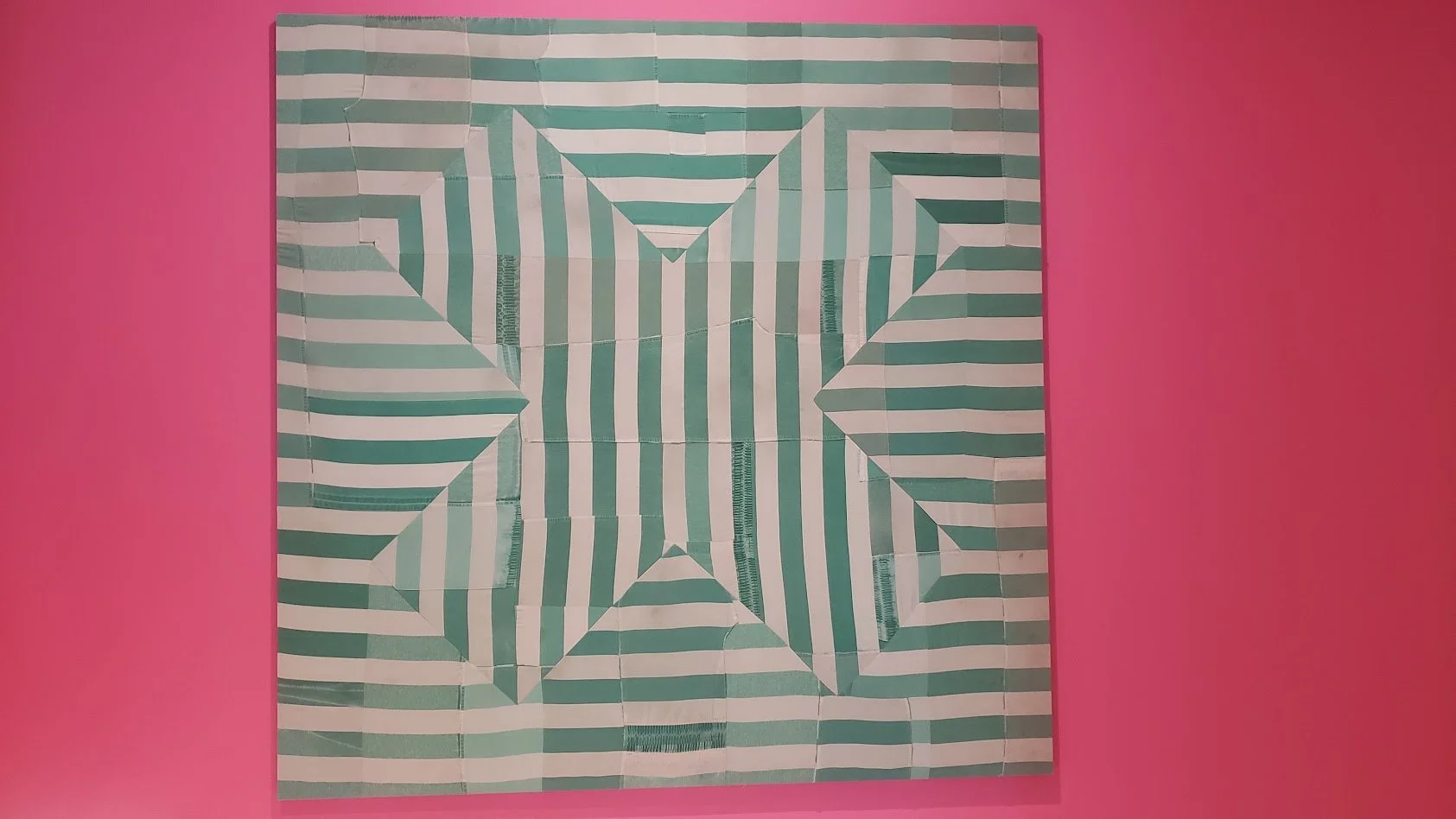
“You Shouldn’t Be a Prisoner of Your Own Ideas” by Hank Williams Thomas
The wall text for Kingston-Jamaica-born Ebony G. Patterson’s collage-like installation “they were just hanging out you know … talking about ... (when they grew up)”, showing a group of happy Black children and young adults in a playful environment, reads:
First evoking childhood memory, [Patterson] then confronts viewers with photos of happy Black children, posing the question, ‘Why are Black youth treated as adult threats?’”
Throughout the installation you encounter bullet-like holes piercing the joyous scenes, making explicit the dangers many Black children face.
Not everything has to be seen through a political lens of course. You can appreciate Nick Cave’s striking use of mediums in his Soundsuit on display, using many repurposed and recycled materials, without knowing that he created his first in this series as a response to the beating of Rodney King by Los Angeles police in 1991.
Cave’s Soundsuits are described as a metaphorical armor to shield against institutional racism and violence. But maybe you are MAGA and want your artistic content free of any diversity, equity and inclusion (DEI) content, in which case I have a short story just for you about a MAGA takeover of MCASD.
Keys and Beatz began collecting in 2014, partly because they felt “there’s not enough people of color collecting artists of color” so if you are MAGA, you might feel you have reason to criticize this exhibition as “woke,” viewing it through the lens of Trump’s disparagement of Diversity, Equity and Inclusion (DEI), which he claims hurts white people.
But the work in this exhibition really doesn’t care. Some of it just reflects on the sheer joy of being alive. Derrick Adams’ large scale four-panel painting and collage “Floaters” depicts Black children having fun in a pool. You could admire it for its cool stylized aesthetics and the joy that radiates from the panels.
This, like many of the works, is a large-scale work.
Maybe the most striking work in this regard is Arthur Jafa’s eight-foot tire sculpture “Big Wheel”, hanging by chain from a gantry, which recalls both Mississippi’s monster truck culture and the state’s history of anti-Black violence:
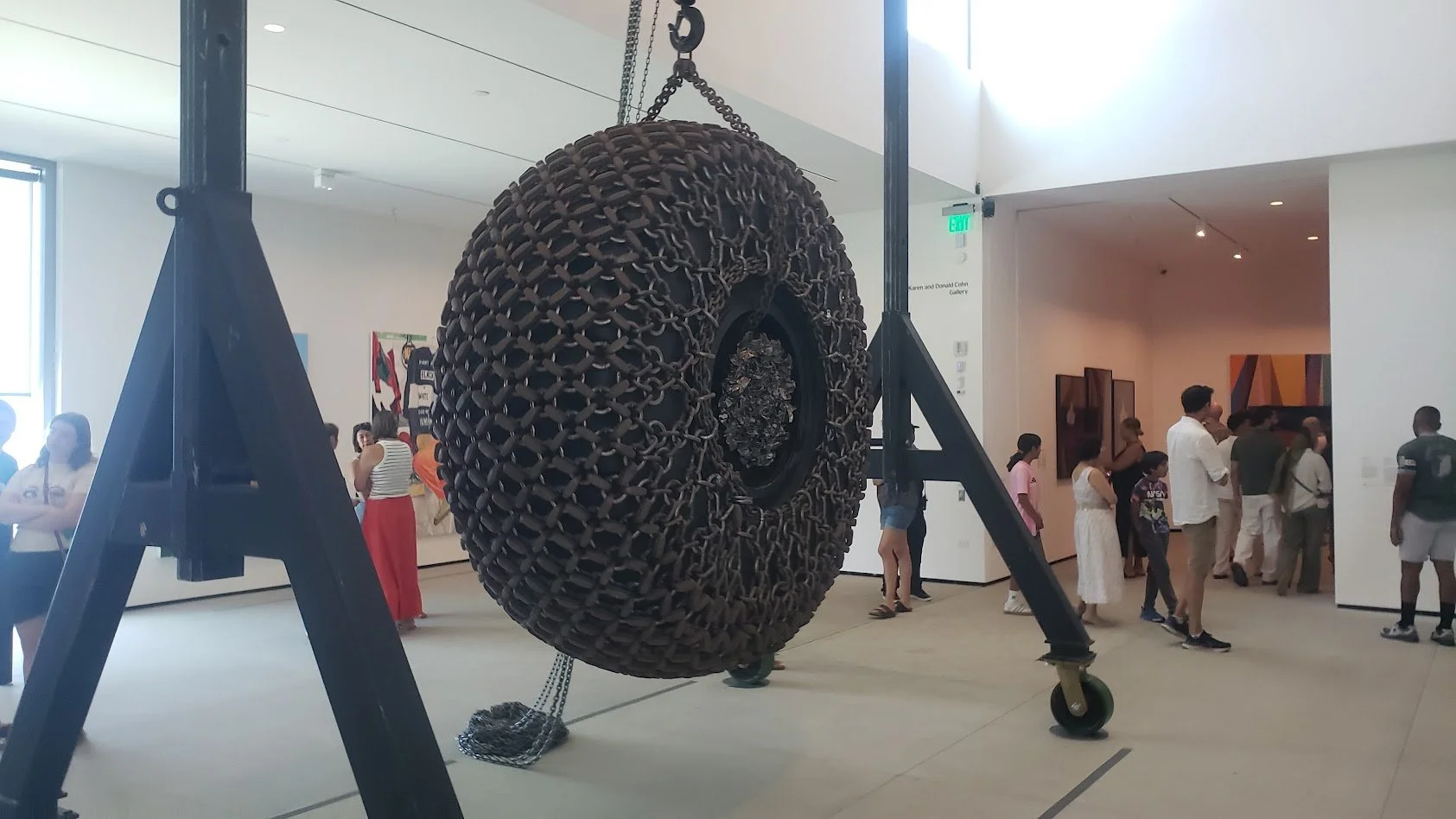
“Big Wheel” by Arthur Jafa
“I’m addressing Black folks, but everyone gets to listen in,” the artist is quoted in the wall text, noting both the particularity and the universality of the work.
Another jaw-droppingly large work in terms of scale is “Bread, Butter, and Power,” a painting installation by Botswana-born Meleko Mokgosi. In a series of vignettes stretching across entire gallery walls, you see scenes of daily life in Southern Africa including South Africa. In these vignettes, the subjects go about their lives amid poverty, amid violence, and the upheavals wrought by colonialism. But there is also the beauty of everyday life: schoolchildren posing for a picture, a man and a woman relaxing on a street corner, a roadside stand loaded with fruit.

“Bread, Butter, and Power” by Meleko Mokgosi Panoramic image by Dan Grossman
With their power as collectors, Keys and Beatz are bringing bread and butter to the tables of Black artists, with their No Commission fair model (similar to that of Indy’s Black art fair Butter) and other innovations. Even at this dispiriting time when civil rights are being snuffed out at the federal level, this exhibition reminds us that artists, collectors, and museums still have enormous power to shape civil space.
I can’t think of a better way for Newfields to rededicate its fourth floor to contemporary art than to host this innovative and thoughtful collection.