A Talk with Viles Dorsainvil, Executive Director of the Haitian Community Help & Support Center in Springfield, Ohio
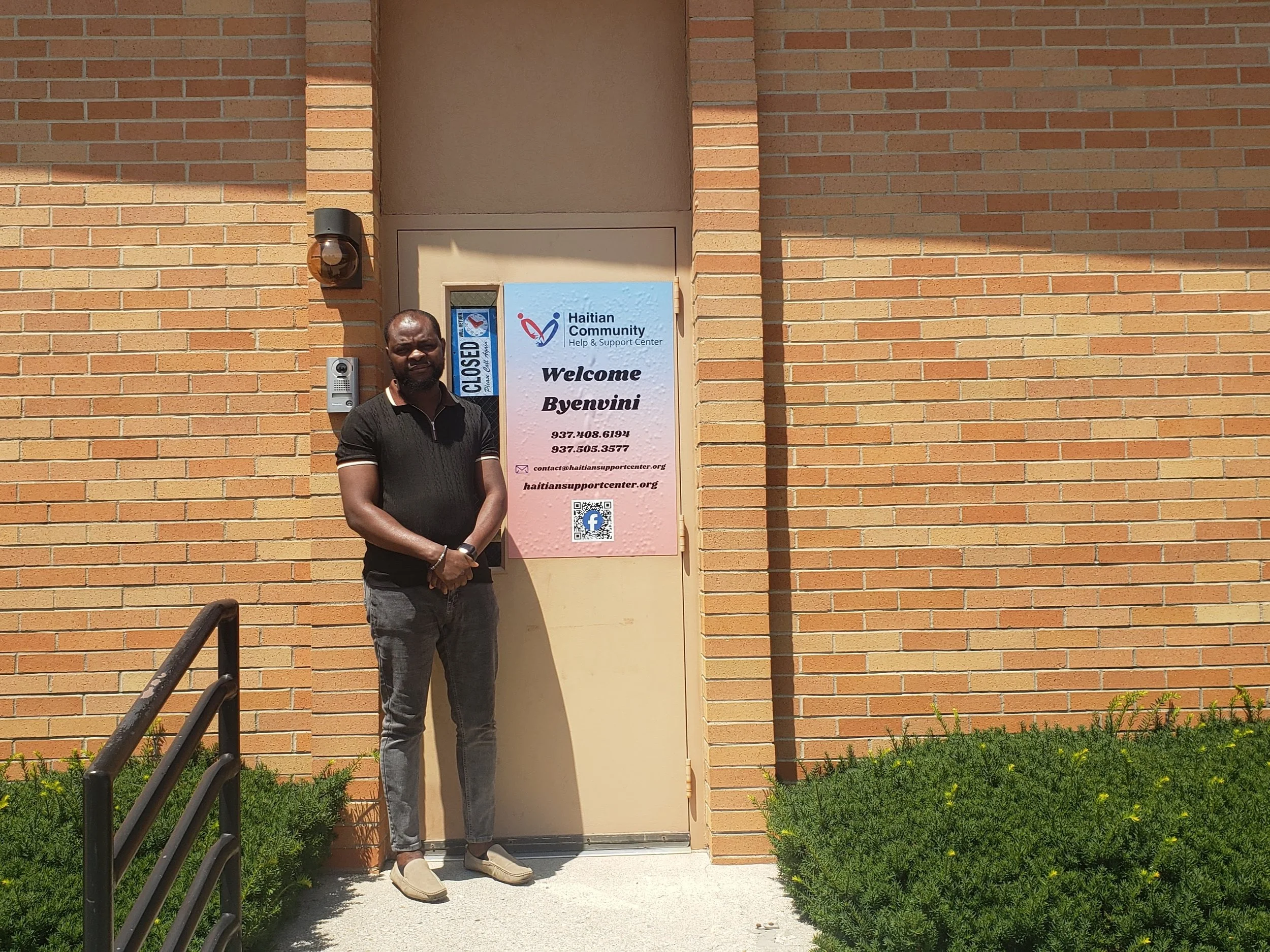
Viles Dorsainvil at the Haitian Community Help & Support Center
On July 3, I interviewed Viles Dorsainvil, co-founder and executive director of the Haitian Community Help & Support Center, in his office in Springfield, Ohio.
That same day, Dave Chappelle appealed to Donald Trump on CNN: “Mr. Trump, please leave those Haitians in Springfield alone. We love them. We love the Haitians.”
In previous interviews, Dorsainvil described how the false rumors and hostile rhetoric directed at Springfield’s Haitian community created widespread fear. Many Haitians, he told me, became afraid to drive or even leave their homes, believing they could be physically attacked.
Much of that fear followed the repeated, unsubstantiated claims—that is, to say, lies—made by Donald Trump and J.D. Vance during the 2024 presidential campaign that Haitian immigrants in Springfield were eating their neighbors’ cats and dogs.
It wasn’t the first time Springfield’s Haitians had encountered hostility, but it thrust the community into the national spotlight. Dorsainvil emerged as one of its principal spokespeople. The Haitian Community Help & Support Center, established shortly before Springfield became the focus of national attention, was created to help Haitian newcomers adjust to life in the city. Volunteers assisted residents with obtaining driver’s licenses, navigating immigration paperwork, applying for jobs, and finding housing. Drawing on his experience as a pastor in Jamaica and on years of community service, Dorsainvil told me he felt called to public service and to helping his community.
During the past week, however, the organization’s priorities have shifted. Rather than focusing primarily on helping newcomers settle in Springfield, the Support Center is now helping Haitian residents prepare for the loss of Temporary Protected Status (TPS) after the Supreme Court allowed the Trump administration to move forward with ending those protections. For roughly 350,000 Haitians nationwide, the decision threatens both their work authorization and their protection from deportation. Many of them arrived in the US in the wake of the earthquake that caused 300,000 and displaced over a million people, and their protected status—approved under the Obama administration—has been renewed by multiple administrations. Haiti is still not safe to return to as much of its territory is controlled by gangs and faces chronic food insecurity.
Springfield is home to an estimated 12,000 to 15,000 Haitian residents, though not all are protected by TPS. Some are seeking other forms of immigration relief, some are lawful permanent residents, and some are U.S. citizens. Some have been in the US since fleeing the 2010 earthquake that killed approximately 220,000–250,000, according to widely cited Haitian government and UN estimates, and have had their TPS status continually extended by multiple administrations. But for those whose legal status depends on TPS—and for the city they have helped reshape—the future remains uncertain. What is clear at this point: the end of TPS will force many Haitians to make very hard choices.
I started this interview, which has been edited for clarity and continuity, by asking Dorsainvil for his recommendations to the Haitian community in the wake of the June 25 Supreme Court ruling.
DORSAINVIL: We spoke with members of the community on Zoom, in partnership with ABLE [Advocates for Basic Legal Equality, Inc.]. The representative from Able was able to give them some legal advice. We were also trying to help them to explore some of the avenues. One of the options is that if there is a third country where they want to go. For example, if some of them might be interested in going to Canada. But they have to have an immediate family member to receive them in Canada, because it’s not that easy to just cross that border. The other option is for them to develop plans for their own safety and the safety of their kids, because we don’t know after July 10 if there won’t be any raids by ICE [Immigration and Customs Enforcement]
INDY CORRESPONDENT: Who gave July 10 as a date?
DORSAINVIL: There was an update on the USCIS [US Citizenship and Immigration Services] website where July 10 would have been like the date with work authorization will expire, and I read something on a group this morning that somebody shared with us… They shared this message from yesterday to say that the DC Circuit court declined to issue an emergency order to lift the stay of Haitian TPS termination. Instead, they ordered a briefing, which will be completed on July 20. This means that TPS should remain intact until at least July 20.
INDY CORRESPONDENT: But work authorization, no matter what…
DORSAINVIL: …will end July 10. So now we tell them, for those of them who have homes, we ask them to get in touch with the real estate agents who helped them buy those homes. That’s if they can manage those homes for them, in case something happens to them. We also tell them if they have businesses, they have to speak with a lawyer to know how they can transfer this business to a person who has a more permanent resident [status] that can manage the business for them, so we tell them to try to sign a power of attorney. If something happens to them, they will know that somebody else that they trust has the guardianship of the kids. So, at the end of the day, every single action that could help them to be safer—they have to take those actions for their own safety.
So if they want to, it’s their choice if they want to self-deport, because at the end of the day this is the goal of the [Trump] administration when they take away the privilege that you have to work, so you know that folks here live paycheck to paycheck. Now you get to a situation where you cannot work, you cannot provide for yourself or your family automatically, life becomes unbearable, and you don’t have any other choice but to leave, so because if you’re not doing something, you will starve to death.
INDY CORRESPONDENT: Does this apply to independent business owners, as well? I just had lunch in KEKET Bongou [a restaurant owned and managed by a TPS holder].
DORSAINVIL: People like [the KEKET Bongou owner] she has to start thinking about what she’s going to do with the business if she has TPS, so she has to maybe think about speaking with a person who has a more permanent residence [status]...
INDY CORRESPONDENT: How are you guys doing?
DORSAINVIL: We are thriving… It’s a very scary time now. We try to lay low. We cannot say that we are good because we are not, but we have to keep going, because at the end of the day, we have to be there for the community. So many people are relying on us… We have to be here for them, but we also try to make sure that we are okay by ourselves when it comes to safety.
INDY CORRESPONDENT: What has been the general reaction of Haitians when you talk to them?
DORSAINVIL: I think they are confused, because what happened is the TPS case was in the lower court before, [then] the federal court, [and then] the Court of Appeals—there was that type of back and forth. Judges from the lower court always said, “Okay, we take the verdict for TPS to continue.” Now that case is at the Supreme Court, and there was that final ruling. They still believe that this is the case from the lower court. They are not aware that this is the final ruling, and their [caution] is lacking, because they do not know now that we are at the top level of the decision of the Supreme Court… What happened is that they heard the employers tell them not to come back to work. Now they started thinking that it might be serious now, because I know some of the employers, like Amazon, have been telling all the employees not to come back to work since July.
INDY CORRESPONDENT: So as of July 1, they’re not working in Amazon.
DORSAINVIL: And now they start to think that this is serious. I think our responsibility is to raise awareness; that it’s not something in the lower courts anymore, it’s not the back and forth thing in the lower court anymore. It’s the final verdict from the Supreme Court, which means the administration has leeway [to deprive Haitians of the right to work and the right to remain in the country].
INDY CORRESPONDENT: So your job is to, in a sense, dispel magical thinking.
DORSAINVIL: Yeah. We are from a country where folks have the tendency of spiritualizing everything. We also make sure that we tell the pastors, “I know that you believe in God. I know that God is able to do that, but you have to be careful of what you’re telling your congregants all around this time for you to share some type of wishful thinking and put them in more danger instead of telling them the reality, the truth that you will no longer have TPS, and yes, God can still do something, but on your own you have to find a way to do something.”
If you can adjust your status, if there is somebody in your family that can petition for you to adjust your status, you have to do that. If you can apply for asylum, you have to do that. At least asylum won’t guarantee your safety at 100% but there is a legal ground if you are being detained so that a lawyer can look at your case. And we try to make sure that we repeat the feedback we get from the community—that so many folks told us that the employers are already asking them not to come back to work.
INDY CORRESPONDENT: What has been the reaction to the situation from the wider Springfield community and the local government?
DORSAINVIL: I think that the mayor has been very vocal, telling how much useful the Haitians are to Springfield. I think that Governor DeWine has been very vocal as well… I think they have a leadership that is more inclusive based on what I hear them saying. But when you go to City Hall and they open the mic for folks to come in front to speak, you would hear some of the naysayers… The second thing, when there is an article that comes out about us TPS holders, and you go to the comment section, you will see so many people are commenting badly and tell us, “Too bad.” But we have the vast majority of people in Springfield who have been standing in solidarity with us. That’s the sense I had talking to people.
INDY CORRESPONDENT: Yesterday, walking through the Summer Arts Festival and talking with people, I got a similar impression.
DORSAINVIL: That’s been very encouraging [but] we’ve been receiving calls on our cell phones with all these types of n-words asking us to leave, it’s a very unsettling circumstance now to navigate well.
INDY CORRESPONDENT: Thank you. Is there anything else you want to add?
DORSAINVIL: Yeah, I think that I added everything. Well, the only thing is that it’s another chapter in our journey as Haitians. We have been through so many hardships, natural disasters, turmoil, corruption, the situation with the hoodlums [Gangs, rather than the government, are in control of much of the territory in Haiti]. It’s not a question of us not willing to go back, but it’s a question of our safety. Other than that, we are so attached to our country, it wouldn’t mean anything for us to go back home but we know that situation on the ground: the same factors that caused us to leave are still there. So before making any decision, we have to think twice. Other than that, Haitians would have been ready to go back home.