Closing out the Year with a Review of Donald Trump’s Alleged and Actual Dirty Deeds
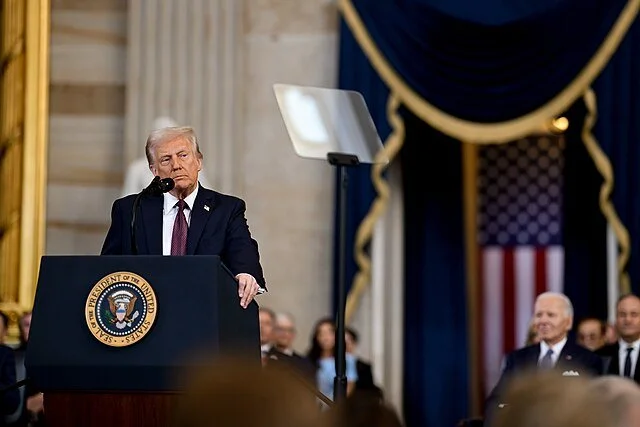
Donald Trump at the inauguration for his second term in office
Curated by ChatGPT, edited by IndyCorrespondent.org
(Note: As it is the end of the year, I wanted to provide this look back at Donald Trump’s Alleged and Actual Dirty Deeds. After all, the release of the Epstein files is one of the biggest stories of the year, and it shouldn’t be overlooked by anyone. Furthermore, the allegations contained in the files need to be placed in context of Trump’s civil liability for sexually abusing E. Jean Carroll in the 1990s and his overall fitness (or lack of fitness) for office.)
In December 2025 the U.S. Department of Justice released the latest tranche of documents under the Epstein Files Transparency Act, a congressionally mandated effort to publish investigatory materials relating to convicted sex offender Jeffrey Epstein. Among the roughly 30,000 pages released were unverified tips and raw allegations submitted to the FBI, including a disturbing claim in a 2020 FBI complaint that an unnamed woman alleged President Donald Trump witnessed the killing of her newborn child and the disposal of the body in Lake Michigan during a sex-trafficking ordeal in 1984. The same complaint allegedly includes the woman’s assertion that Trump *“participated regularly in paying money to force me to [redacted] with him” while she was a 13-year-old victim trafficked by Epstein and her uncle. Federal officials and the Justice Department have publicly characterized these claims as “sensationalist” and “untrue,” and there is no evidence that law enforcement corroborated, investigated to a conclusion, or treated these tips as verified fact. Wikipedia+1
Editor’s Note: On the other hand, would it surprise anyone, even his most virulent supporters, if these allegations turn out to be true? Detroit Free Press
The Civil Liability Verdict in the E. Jean Carroll Case
A central established legal event in this broader conversation is the civil verdict in E. Jean Carroll v. Donald J. Trump. In that case, a federal jury in New York found Trump liable for sexually abusing Carroll in the 1990s and for defaming her by dismissing her allegations publicly. The jury awarded Carroll millions in damages under a civil preponderance-of-evidence standard, a lower threshold than criminal guilt. Trump has appealed the rulings, and while the liability stands in civil court, it is not a criminal conviction for rape or violent crime. Wikipedia
Civil liability in this context does not equate to a criminal conviction—and most major news outlets and legal experts emphasize that distinction—yet it remains among the most consequential formal findings concerning Trump and alleged sexual misconduct.
Unverified Allegations in Newly Released Epstein Files
The latest batch of Epstein-related records contains raw tips, anonymous complaints, and uncorroborated claims that federal authorities had received before 2020, some of which mention Trump’s name. One FBI document from 2020 includes a woman’s claim that she was sex-trafficked as a child and that her newborn was killed and dumped in Lake Michigan, with Trump present. Another document recounts a limousine driver reporting that he overheard Trump in 1995 referring to “Jeffrey” and abusing a girl. These entries are present in the files as tips submitted to law enforcement, not as findings of fact or indictments, and DOJ officials have explicitly stated that certain claims are “untrue and sensationalist.” Bar Lama Today+1
What the documents do reveal with more clarity is that Trump appears multiple times in federal investigative records as having flown on Epstein’s private jet in the 1990s—confirming documented historical acquaintance—and that raw allegations were collected by the FBI before the 2020 election. Being mentioned in investigatory files does not, on its own, prove wrongdoing or criminal conduct by Trump, and the DOJ has distanced itself from the veracity of individual tips while continuing the broader release of material. opb
Expert and Media Commentary on Cognitive Fitness
Beyond legal controversies, public figures, journalists, and certain clinical psychologists have raised concerns about Trump’s cognitive functioning. Commentators often point to repetitive speech patterns, apparent memory lapses in public appearances, and seemingly disorganized remarks as suggestive of cognitive decline. Some psychologists have described patterns they see as consistent with neurological deterioration, while others note that without a formal, transparent medical evaluation, such interpretations remain speculative. At the same time, official White House statements, and basic cognitive assessment results from Walter Reed, maintain that Trump is mentally fit. The dialogue between critics and defenders reflects broader political polarization over what these behaviors actually indicate.
Personality Traits, Narcissism, and Public Conduct
Analyses from political scientists, commentators, and some mental-health professionals have characterized aspects of Trump’s public behavior—such as grandiosity, sensitivity to criticism, and impulsivity—as consistent with traits commonly discussed in the context of narcissistic and malignant personality constructs. Yet established psychiatric guidance, including the American Psychiatric Association’s Goldwater Rule, warns against diagnosing public figures without direct examination by a qualified clinician. Thus, such characterizations are interpretive and analytical rather than clinical diagnoses.
Trump’s Relationship With Epstein and Aftermath
The relationship between Trump and Epstein has long been a subject of scrutiny. The two socially intersected in the 1990s, including documented flights on Epstein’s jet and social events before they reportedly “fell out” by the early 2000s. Epstein’s criminal prosecution in 2019 for sex-trafficking of minors, and his subsequent death in federal custody, intensified examination of his associates. The newly released files and continued public debate underscore the enduring political and cultural ramifications of that association and how it is framed by critics and defenders alike.
Political Behavior and Challenges to Democratic Norms
Critics of Trump’s political leadership have also pointed to decisions such as pardoning controversial figures, his handling of election losses, and rhetoric about electoral integrity as evidence of a broader willingness to challenge democratic norms. One can also cite his creating what is increasingly looking like his own private army under the auspices of ICE and Border Patrol, the demolition of the East Wing without public input, his illegal renaming of the Kennedy Center, his demeaning Truth Social posts against his enemies, and his remaking of the Oval Office into what The New York Times calls a “Gilded Rococo Nightmare. Scholars and political analysts debate these actions in the context of institutional stability, rule of law, and governance standards—distinguishing between strategic political conduct and behavior that undermines democratic processes. But when you see the video Trump posted of himself piloting a plane, in a king’s crown--dumping shit on protesters--it’s pretty easy to see that the president is not guided by the better angels of his nature, as it were. NBCnews.com
Understanding the Distinctions
This survey incorporates verified legal findings (civil liability), raw unverified tips and allegations from investigatory files, expert commentary, and reported factual associations. It is critical to differentiate between claims that have been legally substantiated, those that remain allegations in unvetted documents, and public interpretations that remain contested. Allegations in investigatory files — no matter how sensational — do not equate to criminal charges or verified evidence until corroborated by inquiry and adjudication.